Wednesday, February 25, 2009

In the front seat, going tweet tweet tweet

There was an interesting discussion at uber Leaf Blog (and new Yahoo! partner) PPP yesterday on the NHL, blogs, twitter and social media (you can read that convo here). By happy coincidence, this morning brings us an interview on that very topic with the NHL's Director of Corporate Communications Michael DiLorenzo.

One of the more interesting observations in that piece:

All of the NHLs key metrics are tracking upward revenues, attendance, subscriptions, e-commerce, TV ratings, etc. - but we’re competing with some pretty dramatic storylines that impact billions of people. One of the other challenges I have is keeping up with the growing social media environment, and trying to keep track of everything that is written about our brand.
I think it's great that the NHL has worked hard to be an early adopter of social media. Any time I can get info that doesn't have to pass through the Toronto sports media filter, I'm a happy man.

You can read the interview here and you can follow Mr. DiLorenzo on twitter here.

Monday, February 23, 2009

He Who Laughs Last Didn't Get the Joke

When the Sundin-returns circus ended we all knew the media would move on to yet another all important topic - it's not just nature that abhors a vacuum.

I wasn't sure what would become the defacto big story for the sports writers out there. Perhaps it would be a chimpanzee who can almost calculate pi, a series of columns on trade rumours that will never happen, the endearing story of a career AHLer from some small town who's waited forever for his shot at NHL glory or maybe another profile of an NHL tough-guy that's a gentle giant off the ice.

But to think that sucking sound you hear is the collective brain power of several writers trying to figure out whether or not the Brian Burke on Twitter is the real Brian Burke, that's something I wasn't expecting. I mean, it's not like there's a big hint right in the bio line.


As for the charge that this very clever, acerbic, twitter account is setting back the cause of bloggers - I have no idea what cause that may be; moreover, I'd hate to think what the day to day contribution of sports writers is when they look at the bio line of a twitter account and presume it's a reference to a level playing field for all participants.

Thursday, February 19, 2009

You don't need a weather man to know which way the wind blows

There are numerous reasons I no longer read the sports pages, but the biggest one has to be the pathetic signal to noise ratio. And good old Damien Cox has added yet more noise to the system.

Cox writes (big hat tip to uber Leaf site PPP who save me from having to actually read through this stuff ):

It continues to blow my mind that some insist Mats Sundin "owed" the Leafs the chance to trade him last winter and get draft picks and prospects for him.

Here’s what he owed the Leafs.

He owed them a willingness to play hard under the terms of his contract, to play through injuries, to provide solid leadership, to put points on the board and to set an example for young players. His job was to fulfill his playing contract, period.

To wallow in these ill-conceived, illogical past grievances against the player who was the team’s best for more than a decade is to demean not only him, but the franchise and the sport.

That's all well and good I suppose. I mean, it's not like Cox ever pursues any angles that might demean the Leafs' franchise - oh, wait..well, it's not like Cox was one of the journos who thought the Leaf's rights should be put ahead of Mats Sundin.

Unless of course you were to go to the Leafs TV site and search their video feeds for Fletcher's January 22nd press conference and maybe fast forward to the 17:49 mark. Because if you did that, you might just get to hear Damien Cox ask for a follow-up question about a certain Mr. Sundin (you know, the one who should have his rights come first. The one who didn't owe the Leafs the opportunity to trade him):

Cox: "You said, 'The most important thing is to do what's right for Mats.' Isn't the most important thing to do what's right for the Toronto Maple Leafs? First, ahead of Mats?"
Fletcher: "That's right Damien, but Mats is driving the engine here. He's an unrestricted free agent at the end of the year and he has a no-trade clause."
[long, awkward silence]

That exchange made an appearance in Cox's January 23rd column:

When it came to the possible trading of Sundin, Fletcher said: "The most
important thing is to do what's right for Mats." Questioned further as to
whether it wasn't more vital to do what was best for the hockey club, Fletcher
said: "Mats is driving the engine here."

Well, at least we know who's in charge.

That last line is a smug thing of beauty isn't it? Had Damien just let it alone, those first four lines of his column just wouldn't have that je ne sais quoi of sanctimony and disingeniousness that only Cox can deliver.

How great is it to be able to take shots like that and then 13 months later argue the other side?

Hypocrisy: reason number 1,834 that I longer turn to the sports pages for any insight into the game I love.

Two Minutes (to midnight)

I was prepping a post on PK performance that's taking a bit longer than I expected (some stuff that should be easy to dig out sure is buried at NHL.com) when I stumbled across this, largely meaningless, factoid: the Ron Wilson coached Maple Leafs are currently the fourth least penalized team in the NHL. You read that right, they are 27th in times shorthanded. Here's the trend line:

2008-09 - 27th most penalized
2007-08 - 17th
2006-07 - 11th
2005-06 - 12th
Lockout
2003-04 - 5th
2002-03 - 1st (woo hoo, Leafs are #1!)

For the first time in a long time this club is actually showing some signs of discipline.

Clearly this isn't what Fletcher had in mind when he traded for Hollwegg, but all things considered it's probably for the best as the PK is dead last and Toskala's sv% when the Buds are a man (or two) down is a chilling .852

Now, this post isn't suggesting I don't want a tough club and I know there's no correlation between times shorthanded and regular season or post-season success. And yes, everyone knows full well Anaheim won the cup as the most penalized team in the league. I just found it interesting that in all the discussion of what Ron Wilson may or may not have accomplished in his first year as coach of the Leafs, this trend hasn't been noted.

===
A month or so ago I was contemplating throwing out some Iron Maiden for the title of a post. I ended up going with the Smiths instead and I heard about it in the comments. Because I care so much about my readers (all three of you - hi mum!) I went back to the days of Powerslave for this one (grade 9 if memory serves). It's a track I still have on my iPod right between Radiohead's "2+2=5(The Lukewarm)" and "21 Park Rd." by Bill King (sorry, Canadian Jazz and youtube don't seem to mix).

Saturday, February 14, 2009

Someone created the boxscore, and he should be shot

The virus that infected professional baseball in the 1990s, the use of statistics to find new and better ways to value players and strategies, has found its way into every major sport. Not just basketball and football, but also soccer and cricket and rugby and, for all I know, snooker and darts — each one now supports a subculture of smart people who view it not just as a game to be played but as a problem to be solved. - Michael Lewis, The No-Stats All-Star
Michael Lewis turns in yet another great read, this time about the emergence of stats in the NBA (Money Round-ball?). Lots of parallels here between the NHL and the NBA (trying to find value, the scarcity of low-contract high-performance players, and the emergence of new stats help inform player personnel decisions).

The five players on any basketball team are far more than the sum of their parts; the Rockets devote a lot of energy to untangling subtle interactions among the team’s elements. To get at this they need something that basketball hasn’t historically supplied: meaningful statistics. For most of its history basketball has measured not so much what is important as what is easy to measure — points, rebounds, assists, steals, blocked shots — and these measurements have warped perceptions of the game. (“Someone created the box score,” Morey says, “and he should be shot.”)

What I wouldn't give for this piece to be about the NHL...

Read Michael Lewis' New York Times Magazine Article here.

Friday, February 13, 2009

The sun's not brighter here, it only sines on golden hair

In the past week, the Leafs have exposed Kronwall, Williams, Devereaux and Battaglia to waivers.

Kronwall was claimed by the Caps, Williams passed through to the Marlies (if he hadn’t, Canada might have been treated to the sight of Don Cherry suffering from a massive intraparenchymal hemorrhage on national TV during Coach’s Corner) and the fate of Devereaux and Battaglia will be known by noon on Friday.

Burke’s stated vision for the Leafs is to have six forwards that are offensive threats and six that can muck it up. If Williams can’t be in the top six (and it seems 29 other NHL GMs would agree with that assessment) he certainly doesn’t have the size, work ethic, or fists to be on the bottom six.

So what gives with the other three guys?

There’s a term in the CBA called the "Reserve List" which dictates the maximum and minimum number of players an organization can have at one time.

The Reserve List includes all the players a club holds the rights to, including all unsigned draft choices, all players signed to a Standard Player Contract (SPC) – even if they are not currently playing in the NHL – and all players who have signed an SPC but who have subsequently been returned to Juniors.*

An NHL team is permitted to have up to 90 players on their reserve list; however, only 50 of those players can be signed to a SPC.

With the Leafs carrying 22 players and the Marlies carrying 25, the organization has 47 players signed to SPCs. Add in goalie James Reimer (who for some reason isn’t on the Marlies web-page roster) and that makes 48. Kronwall would have put the organization at 49. With a max limit of 50, that doesn’t give Burke a lot of wiggle room at the trade deadline.

It’s been suggested that there’s some sort of altruism going on with Leafs management, that players are being waived so they can have one more shot at the bigs or they're being rewarded for their hard work and strong play with the Marlies.

That may be true, but my guess is the Leafs are exposing so many players in the hopes that one or two of these guys get claimed by another club, the Leafs SPC number drops by another body or two, Burke gets some room on the Leafs Reserve List and, most importantly, the organization has a bit more flexibility at the trade deadline.


*Players under 19 who have played 10 NHL games or less and are returned to Junior do not count against the first 50 on the reserve list, but do count as part of the organizational 90.

What's the strange title of this post all about? Click here.

Tuesday, February 10, 2009

I Used to Play Bass for Sly

Heard any good trade rumours lately? Any of those rumoured deals actually happen?

Perhaps it's best to ignore all those alledged hot deals out there unless you're looking to drive traffic to certain web sites, you're a fan of Bruce Garrioch or one of the the trade deadline or the NHL draft is right around the corner, but I'm getting ahead of myself....

Trade Patterns

I presumed that these rumoured deals (well, at least the reasonable ones) were safe to ignore because post-lockout, trades in general weren't happening. Then I crunched the numbers (ok, I counted lists) and I was rather surprised to find that, on average, between October and February five trades happen each and every month in the NHL.

That might seem like a lot of trades (and it's way more than I expected to find) but then I took a closer look who is changing jerseys - it’s like I discovered a new game called "spot the AHLer."

This is a list of every player traded between the opening game of this season and today (February 11, 2009). How many of these players do you recognize? Is there a single super star among them? Belak doesn’t count.

Andrew Alberts
Wade Belak
Phillipe Boucher
Sheldon Brookbank
Matt Carle
Carlo Coliachovo
Steve Downie
Robbie Earle
Steve Eminger
Drew Fata
Jonathon Filewich
Dan Fritsche
Josh Gratton
Ryan Hamilton
Andrew Hutchison
Hugh Jessiman
Lukas Krajicek
Jason Labarbera
Junior Lessard
Joakim Lindstrom
Ned Lukacevic
Michael Lunden
Brad May
David McIntyre (traded twice)
Alexander Nikulin
Shane O’Brien
Michel Oullet
Adam Pineault
Eric Reitz
Tim Ramholt
Juraj Simek
Alex Steen
Lee Stempniak
Logan Stephenson
Brian Sutherby
Darryl Sydor
Nick Tarnasky (traded twice)
Lauri Tukonen
Jason Williams
Clay Wilson (traded twice)

I recognized just 17 of the 40 names on the list and I think of myself as a pretty tuned-in hockey fan.

Lee Stempniak, with 27 points (on pace for 40) is the player with the highest point totals and, I suppose, one of the most recognizable names.

Lee Stempniak. Seriously.

I’ll let the soak in for a minute.

Next time you read that Khababulin is headed to the Sens, Hossa is going to Montreal or Gomez is headed to the Canucks, remember that Alex Steen and Carlo Coliachovo for Lee Stempniak is the "blockbuster" deal of 2008.

Clearly, these are not the names that fuel hockey daydreams, click throughs, message board chatter and media columns.

Deadline Dealing

This is not to say that big deals don't happen, rather trades between October and February tend to be small beer. But things certainly heat up at the trade deadline.

In fact, that little window represents about 55% of regular season trade activities.

In 2005-06, there were 35 regular season trades and an additional 35 trade deadline deals.

In 2006-07, there were 30 regular season trades and an additional 46 deadline deals.

In 2007-08, there were just 21 regular season trades and an additional 26 deadline deals.

This year, there have been 28 trades to date. I suspect the trade deadline will come close to eclipsing that total (a chart for those of you with a blurry General Shwartzkopf fetish):


Save Your Rumours for the Off-Season

This is where the rumours should be circulating. Nothing like talking hockey in June, because on average, 22 trades are made each June - that's four times the in-season monthly average.

Last year, a stunning 45 deals went down around the NHL draft. You read that right, more trades happened in and around the third week of June 2008 than transpired between all of October and May of 2007-08 combined.

Here's what an active trading calendar looks like from October 2005 to February 2009:

Not hard to spot the trade deadline and NHL draft day.

Free Agency Season

And to get a bit more perspective on player transactions (or lack thereof) let's look at the number of players who change teams through free agency each off-season (excluding players who re-sign with their own teams).

The total is just slightly more than the number of players that are traded throughout the entire year: 139 in 2006-07; 112 in 2007-08; and 129 this past off-season.
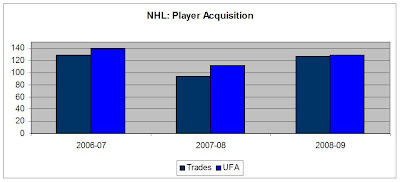

What do these numbers tell us?

Burke has two upcoming windows to make a mark on this club: the trade deadline and draft day. More trades take place on draft day and trade deadline day than the rest of the year combined.

Teams are slightly more likely to acquire a player via free agency as they are through trade.

In the regular season, marginal players are far more likely to be traded than front-line talent.

Friday, February 06, 2009

Darling don't you go and cut your hair

ESPN.com surveyed 193 NHL players (that's about 20 percent of the league) on a number of topics. This one stopped me in my tracks:

QUESTION 7: WHO IS THE BEST REFEREE IN THE NHL?
TOP VOTE-GETTER: Kerry Fraser (18%).


Man, those NHLers sure do have a good sense of humour...